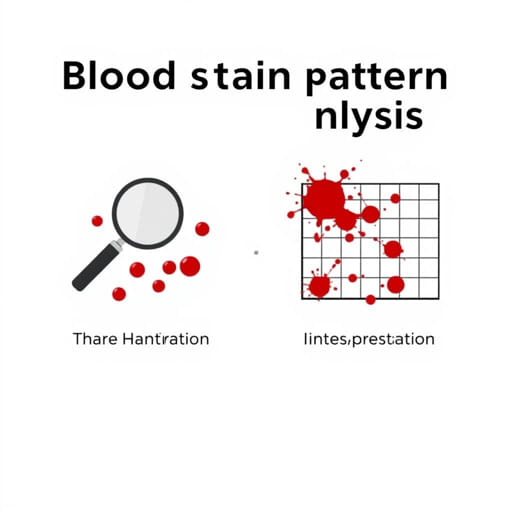
Bloodstain pattern analysis is a crucial element in forensic science, often playing a significant role in reconstructing events at a crime scene. It involves the examination of blood patterns to determine the nature, timing, and mechanism of the events that led to the bloodshed. Understanding how blood behaves under different circumstances allows investigators to draw conclusions about what may have happened, who may have been involved, and how the scene evolved. One of the foundational concepts in bloodstain pattern analysis is that it is carried out in two primary phases, each serving a unique and essential purpose in the investigative process.
Overview of Bloodstain Pattern Analysis
Bloodstain pattern analysis (BPA) is the study of the shapes, sizes, and distribution of bloodstains at a crime scene. It is used by forensic experts to determine what actions occurred and how they relate to the injuries and individuals involved. The discipline relies on the principles of biology, physics, and mathematics to interpret the patterns. For effective analysis, BPA is generally divided into two main phases: pattern classification and event reconstruction.
Phase One: Pattern Classification
The first phase of bloodstain pattern analysis is known as pattern classification. This phase is primarily observational and analytical. It focuses on identifying and categorizing the various bloodstains found at a scene based on their physical characteristics. The goal is to recognize specific types of patterns that can suggest how the blood was deposited.
Types of Bloodstain Patterns
Within this phase, bloodstains are grouped into categories, typically divided into three main types:
- Passive stains: These are formed purely by the force of gravity. They include drops, drips, and pools of blood. They often occur when an injured person remains stationary or when blood drips from a wound.
- Transfer stains: These occur when a blood-covered object comes into contact with another surface. Examples include smears, wipes, or handprints left on walls or floors.
- Projected stains: These result from blood that is subjected to force. Examples include impact spatter (caused by blunt force), arterial spurting, or cast-off patterns (from a swinging object).
Visual and Microscopic Analysis
In pattern classification, forensic analysts closely examine the size, shape, and distribution of each bloodstain. They may use magnification tools or digital imaging techniques to better understand the fine details. For example, a small, mist-like spatter may indicate high-velocity impact, such as from a gunshot, while larger, elongated stains may suggest blood thrown from a swinging object.
Importance of Angle and Directionality
One important aspect of this phase is determining the angle and direction from which blood droplets traveled. By analyzing the shape of the stains especially the tail or elongation of each droplet analysts can calculate the angle of impact. This information can later assist in identifying the point of origin and movement of the victim or assailant.
Phase Two: Event Reconstruction
Once the patterns have been classified and analyzed, the second phase event reconstruction begins. This phase is interpretive and logical. It combines the results of the classification phase with other forensic evidence to form a coherent narrative of the crime. The goal is to reconstruct the sequence of events that led to the creation of the bloodstains.
Reconstructing the Scene
In this phase, investigators attempt to answer questions like:
- What position was the victim in when injured?
- Was the victim moving or stationary?
- What type of weapon might have been used?
- How many blows were delivered?
- Was the attacker standing, crouching, or above the victim?
Using bloodstain pattern data, investigators can create diagrams, 3D models, or even virtual reconstructions of the crime scene to visualize and test different theories of what happened.
Correlating With Other Evidence
Event reconstruction doesn’t happen in isolation. It must be coordinated with other forms of evidence such as DNA analysis, fingerprints, witness statements, and autopsy results. Bloodstain patterns may either confirm or contradict other findings. For instance, if a suspect claims they were never near the victim, but cast-off patterns indicate close proximity, the story may be reevaluated.
Testing Hypotheses
During this phase, analysts may simulate scenarios to test theories. They might use mannequins, synthetic blood, and similar environments to recreate the conditions of the scene. This helps validate assumptions about how certain stains were produced and can reveal new insights that were not immediately obvious.
The Role of Blood Dynamics
Understanding how blood behaves under different types of force is essential to both phases of BPA. Blood acts as a fluid and responds to momentum, gravity, surface texture, and other physical forces. Analysts must consider all these variables to correctly interpret both individual stains and the overall scene. For instance, the same blow can produce very different patterns depending on the type of weapon used, the angle of impact, and whether the surface is absorbent or smooth.
Training and Expertise Required
Bloodstain pattern analysis requires specialized training. Analysts must be well-versed in physics, biology, and forensic methodology. Misinterpretation can lead to incorrect conclusions, which is why both phases classification and reconstruction must be performed carefully and systematically. Courts often rely on expert testimony from BPA specialists, so the credibility of the analyst and the accuracy of the analysis are critical.
Limitations and Challenges
While bloodstain pattern analysis can be powerful, it’s not without limitations. Some patterns may be degraded or altered by cleaning, weather, or environmental factors. Others may be ambiguous or overlap with multiple causes. That’s why both phases of analysis must include a careful review of context, consistency, and probability, rather than assumptions or speculation.
Applications in Real Cases
Bloodstain pattern analysis has been used in countless criminal cases to clarify events. From violent assaults to accidental injuries, BPA provides insights that can support prosecution or defense arguments. In some instances, it has helped exonerate the wrongfully accused by revealing that the blood patterns did not match the alleged actions. In others, it has been instrumental in proving intent or reconstructing the timeline of events with high accuracy.
Understanding the two phases of bloodstain pattern analysis pattern classification and event reconstruction is essential for appreciating its role in forensic science. Pattern classification lays the foundation by identifying and categorizing the various types of stains. Event reconstruction builds on that information to piece together what likely occurred. Together, these phases help investigators form a clearer picture of the crime scene, ultimately aiding in the pursuit of justice. Though complex and sometimes controversial, bloodstain pattern analysis remains a valuable tool in modern criminal investigations.