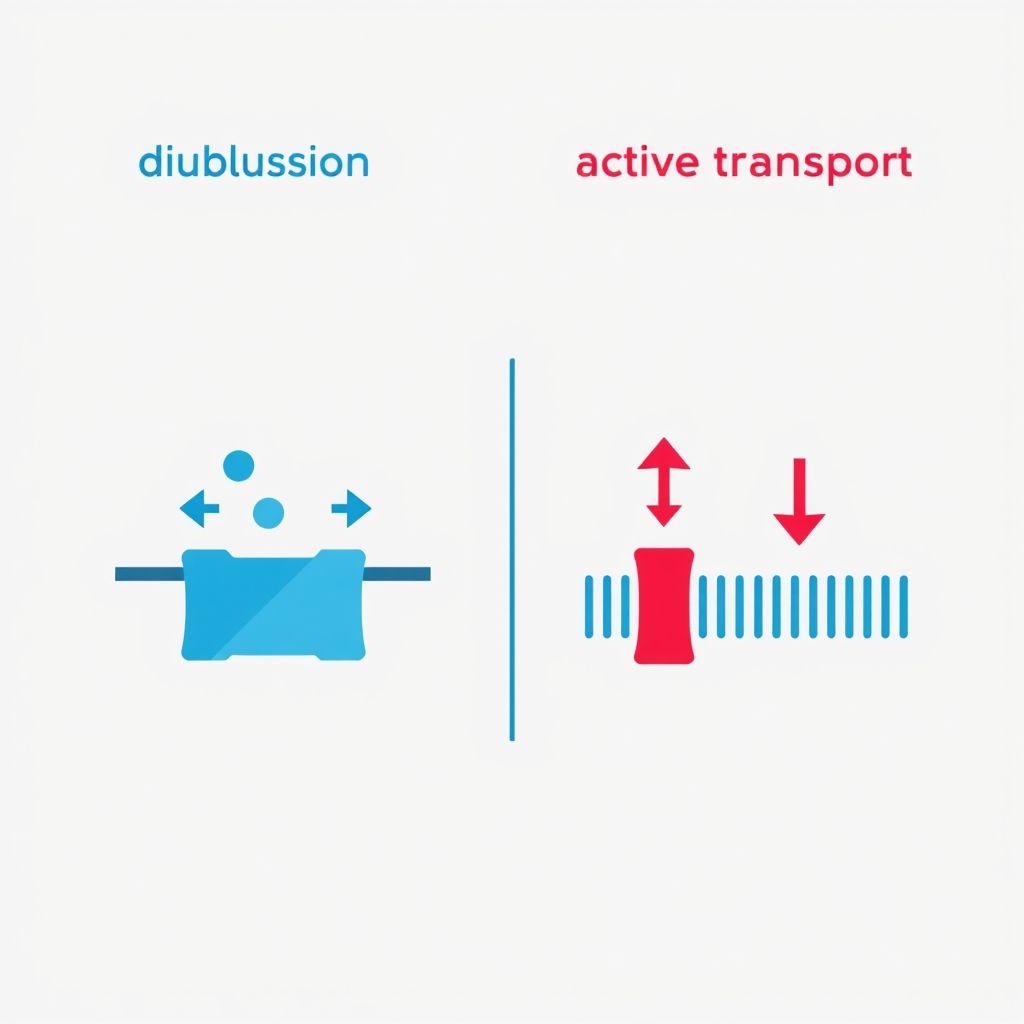
Key Differences Between Facilitated Diffusion and Active Transport in CellsCells rely on various transport processes to move substances in and out of their membranes. Two of the most essential mechanisms are facilitated diffusion and active transport. While both involve the movement of molecules across the cell membrane, they differ significantly in terms of energy usage, direction, and function. Understanding these differences helps clarify how cells maintain balance and carry out life-sustaining activities.
What Is Facilitated Diffusion?
Facilitated diffusion is a type of passive transport that allows molecules to cross the cell membrane with the help of transport proteins. This process does not require energy (ATP) and occurs along the concentration gradient, meaning from an area of higher concentration to an area of lower concentration.
Key Features of Facilitated Diffusion
-
Passive process (no energy required)
-
Uses channel or carrier proteins
-
Moves substances down the concentration gradient
-
Helps transport molecules like glucose, amino acids, and ions
What Is Active Transport?
Active transport is the movement of molecules against the concentration gradient, from a region of lower concentration to a region of higher concentration. This process requires cellular energy in the form of ATP and typically involves specific carrier proteins known as pumps.
Key Features of Active Transport
-
Active process (requires ATP)
-
Moves substances against the gradient
-
Involves carrier proteins like sodium-potassium pumps
-
Essential for maintaining concentration differences in cells
Main Differences Between Facilitated Diffusion and Active Transport
To better understand how these two processes differ, let’s compare them based on several important factors.
1. Energy Requirement
Facilitated diffusion is an energy-free process. Since it works with the natural flow of the concentration gradient, the cell does not need to spend ATP. In contrast, active transport consumes energy because it moves molecules in the opposite direction of where they naturally want to go.
2. Direction of Movement
Facilitated diffusion only allows molecules to move from areas of high concentration to low concentration, helping to balance concentration levels across the membrane. Active transport, however, moves molecules from low to high concentration, often concentrating essential ions or nutrients inside the cell.
3. Type of Proteins Involved
Both processes involve specialized proteins, but their roles differ. In facilitated diffusion, channel proteins form pores for specific molecules to pass through, while carrier proteins change shape to move substances. In active transport, pump proteins are used, which undergo conformational changes powered by ATP to move substances.
4. Speed and Control
Facilitated diffusion is usually faster when there is a steep concentration gradient. However, it is limited by the number of transport proteins available. Active transport can work regardless of concentration, giving the cell greater control over internal conditions, but it is generally slower and more energy-intensive.
5. Examples in Living Organisms
Facilitated Diffusion Examples
-
Glucose transport into cells using GLUT proteins
-
Ion movement such as chloride or potassium through channels
Active Transport Examples
-
Sodium-potassium pump in nerve cells
-
Proton pumps in the stomach lining
These examples show how cells use both processes for different needs depending on the situation.
Why Are Both Processes Important?
Cells use facilitated diffusion when they need to efficiently absorb or expel substances without using energy. This is useful in conserving ATP and maintaining balance.
Active transport, however, allows cells to build and maintain concentration gradients that are essential for processes like nerve impulse transmission, nutrient absorption, and pH regulation.
Summary Table Facilitated Diffusion vs Active Transport
| Feature | Facilitated Diffusion | Active Transport |
|---|---|---|
| Energy Required | No | Yes (ATP) |
| Direction of Movement | High to low concentration | Low to high concentration |
| Type of Transport Protein | Channel and carrier proteins | Carrier proteins (pumps) |
| Gradient Dependency | Depends on concentration gradient | Works against the gradient |
| Speed | Fast (depends on gradient) | Slower (energy-dependent) |
| Example | Glucose transport | Sodium-potassium pump |
Role in Homeostasis
Both facilitated diffusion and active transport are vital in maintaining homeostasis, the stable internal environment of a cell. They regulate ion balance, nutrient uptake, and waste removal, all of which are necessary for the cell to function normally.
For example, neurons rely on the active transport of sodium and potassium ions to create electrical signals, while red blood cells use facilitated diffusion to absorb glucose from the bloodstream.
Similarities Between the Two Processes
Despite their differences, these transport mechanisms share some common traits
-
Both involve specific membrane proteins
-
Both are highly selective, allowing only certain substances to pass
-
Both play a role in cell survival and function
-
Both are influenced by external conditions like temperature and pH
These similarities reflect how cells use a variety of tools to manage their internal environment precisely.
Understanding the difference between facilitated diffusion and active transport reveals the incredible efficiency of cellular function. While one allows the passive movement of molecules based on concentration, the other actively works against it using energy. Together, they ensure that cells get what they need, remove what they don’t, and stay balanced under changing conditions.
By mastering how these two systems operate, we gain a better appreciation of cellular transport, a foundation for topics in health, medicine, and biology.