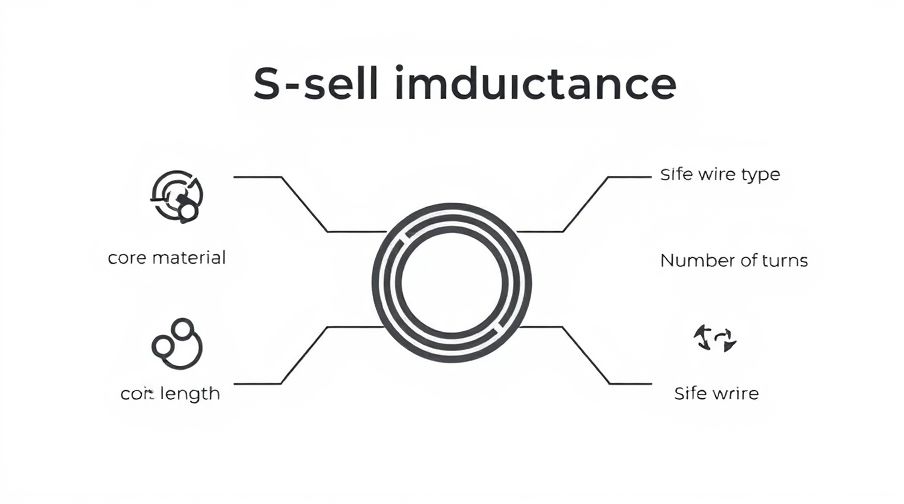
What Factors Does Self-Inductance Depend On?Self-inductance is a fundamental concept in electromagnetism that describes the ability of a coil or conductor to induce a voltage in itself when the current flowing through it changes. This phenomenon occurs due to the magnetic field created by the current, which interacts with the conductor to resist changes in the current. Understanding the factors that affect self-inductance is essential for designing efficient electrical circuits and devices. In this topic, we will explore the key factors that influence self-inductance and explain how they contribute to its behavior.
What is Self-Inductance?
Before diving into the factors affecting self-inductance, let’s take a moment to define the term. Self-inductance refers to the property of a coil or conductor that enables it to resist changes in the current flowing through it. When current flows through a coil, it generates a magnetic field. If the current changes, the magnetic field changes, which, according to Faraday’s Law of Induction, induces an electromotive force (EMF) that opposes the change in current. This resistance to changes in current is what is referred to as self-inductance.
The unit of self-inductance is the henry (H), and it depends on several factors that influence the strength and behavior of the magnetic field created by the current.
Key Factors That Affect Self-Inductance
Several physical properties and characteristics of the conductor or coil influence self-inductance. These factors determine the strength of the magnetic field and, therefore, the resistance to changes in current. Let’s explore these factors in detail.
1. Number of Turns (Coil Windings)
One of the most significant factors influencing self-inductance is the number of turns in a coil. A coil with more turns will have a greater ability to store magnetic energy, resulting in a higher self-inductance. This is because each additional turn contributes to the overall magnetic field, and more turns lead to a stronger interaction between the current and the magnetic field.
For example, in a solenoid, adding more turns of wire increases the self-inductance because the magnetic field produced by each turn combines to create a stronger overall field.
2. Coil Geometry (Shape and Size)
The geometry of the coil also plays a significant role in determining its self-inductance. The shape and size of the coil affect how the magnetic field is distributed and how much area the field covers. The key aspects of coil geometry include
-
Length of the coil A longer coil generally produces a higher self-inductance, as it increases the area over which the magnetic field is spread.
-
Cross-sectional area A coil with a larger cross-sectional area will have a stronger magnetic field, which contributes to a higher self-inductance.
For example, a coil with a larger diameter will have a higher self-inductance compared to a coil of the same number of turns but smaller diameter.
3. Core Material (Magnetic Permeability)
The material used as the core of the coil has a major impact on its self-inductance. The magnetic permeability of the core material determines how easily the magnetic field can pass through it. Materials with higher magnetic permeability, such as iron, allow for a more concentrated magnetic field, which increases self-inductance.
When a coil is wound around a ferromagnetic core, the self-inductance increases because the core enhances the magnetic field. This is why inductors and transformers often use iron or other high-permeability materials as cores to boost their inductance.
4. Current Flowing Through the Coil
While the current does not directly affect the self-inductance value itself, the magnitude of the current influences the strength of the magnetic field. A higher current produces a stronger magnetic field, which in turn results in a greater opposition to changes in the current. This interaction is described by Lenz’s Law, which states that the induced EMF will always oppose the change in current.
So, while the self-inductance remains constant for a given coil, the effect of self-inductance becomes more pronounced when higher currents are involved because the induced EMF becomes stronger.
5. Coil Arrangement and Orientation
The way the coil is oriented and arranged can also influence its self-inductance. If a coil is placed in a way that the magnetic field lines are concentrated or aligned in a particular direction, the inductance may be higher due to the more efficient use of the magnetic field. Coils that are arranged with minimal spacing between them can create stronger mutual interactions, which may slightly increase their self-inductance.
Additionally, coils that are wound in a certain direction (e.g., clockwise or counterclockwise) may influence how the magnetic fields interact, which can affect the self-inductance of the coil.
6. Temperature
Temperature can also affect self-inductance, particularly in materials with temperature-dependent magnetic properties. As temperature increases, the resistance of the conductor typically increases, which can slightly affect the coil’s inductance. Additionally, in materials like superconductors, changes in temperature can drastically alter the magnetic properties of the material, thus impacting the inductance.
In general, however, temperature changes have a relatively small effect on the self-inductance of coils made from ordinary conductive materials, unless extreme temperatures are involved.
Applications of Self-Inductance
Understanding the factors that influence self-inductance is important for a wide range of applications. Here are a few examples where self-inductance plays a key role
1. Inductors
Inductors are passive electronic components that rely on self-inductance to resist changes in current. By adjusting the number of turns, coil geometry, and core material, engineers can design inductors with specific inductance values for various applications, such as filtering signals in power supplies or radio circuits.
2. Transformers
While transformers rely on mutual inductance for energy transfer between coils, the self-inductance of each coil plays an important role in determining the efficiency and performance of the transformer. A higher self-inductance in the coils ensures that the transformer can better manage changes in current, improving its ability to step up or step down voltage efficiently.
3. Motors and Generators
In motors and generators, coils with high self-inductance are often used to produce and manage the magnetic fields required for their operation. The self-inductance of the coils helps control the rate at which the magnetic field changes, affecting the performance and efficiency of these machines.
Self-inductance is a critical property of coils and conductors that allows them to resist changes in the current passing through them. Several factors influence self-inductance, including the number of turns in the coil, the coil’s geometry, the material of the core, and the current flowing through the coil. Understanding these factors is essential for designing efficient electrical circuits and devices, from inductors and transformers to motors and generators. By carefully considering these factors, engineers can optimize the performance of electrical components and systems that rely on self-inductance for their operation.